


Introduction
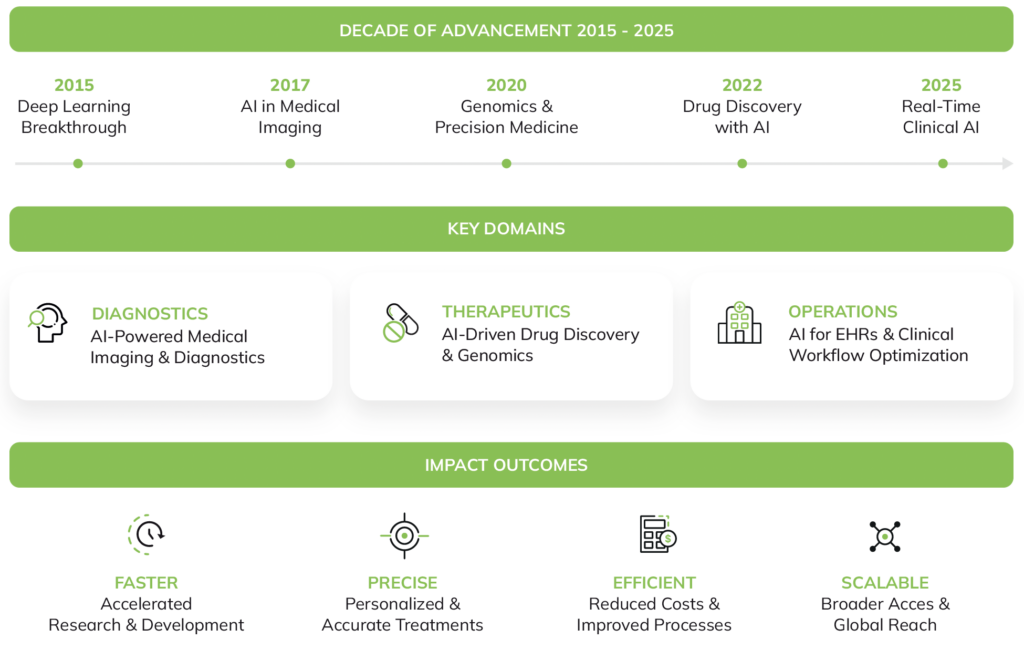
Biomedicine, the core of modern healthcare, has entered a pivotal decade shaped by advances in Artificial Intelligence (AI). As organisations contend with rising data complexity across genomics, imaging, electronic health records (EHRs), and real-world evidence, AI has become a powerful tool rather than a research experiment. Machine learning and deep learning now drive faster discovery cycles, more precise diagnostics, and efficient clinical operations.
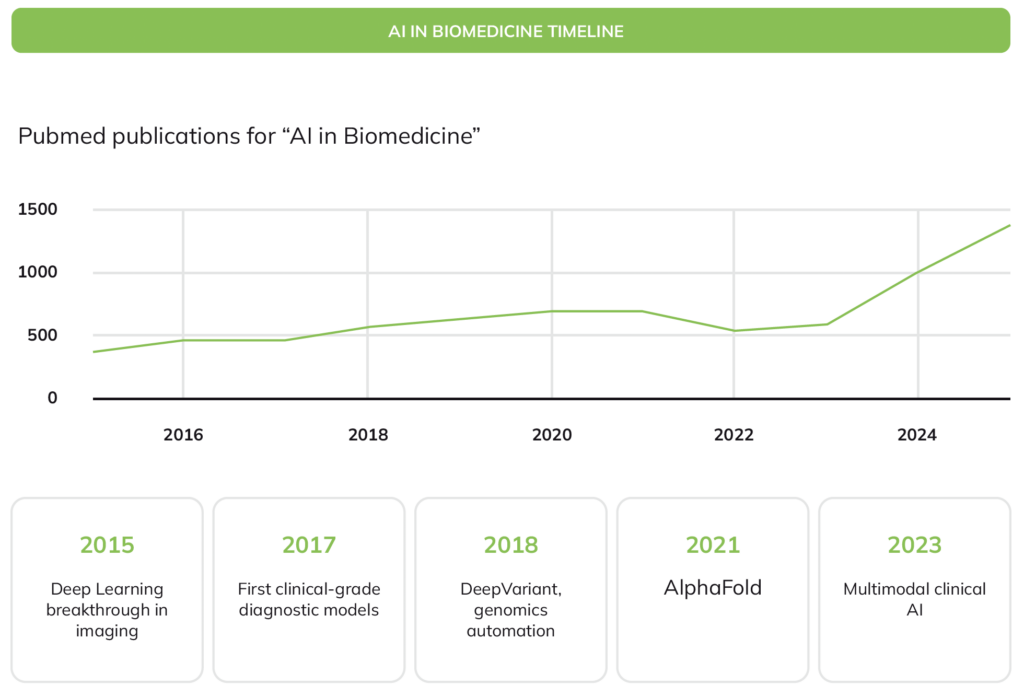
Before 2015, AI in healthcare was limited by small datasets and rule-based systems with little clinical impact. The past decade reversed this trajectory, with breakthroughs in deep learning, scalable computing, and access to multimodal biomedical data.Today, AI is integrated across R&D, clinical workflows, and public health infrastructure.
Companies that successfully implement AI will lead the next era of precision medicine and data-driven healthcare.
Foundations of AI in Biomedicine
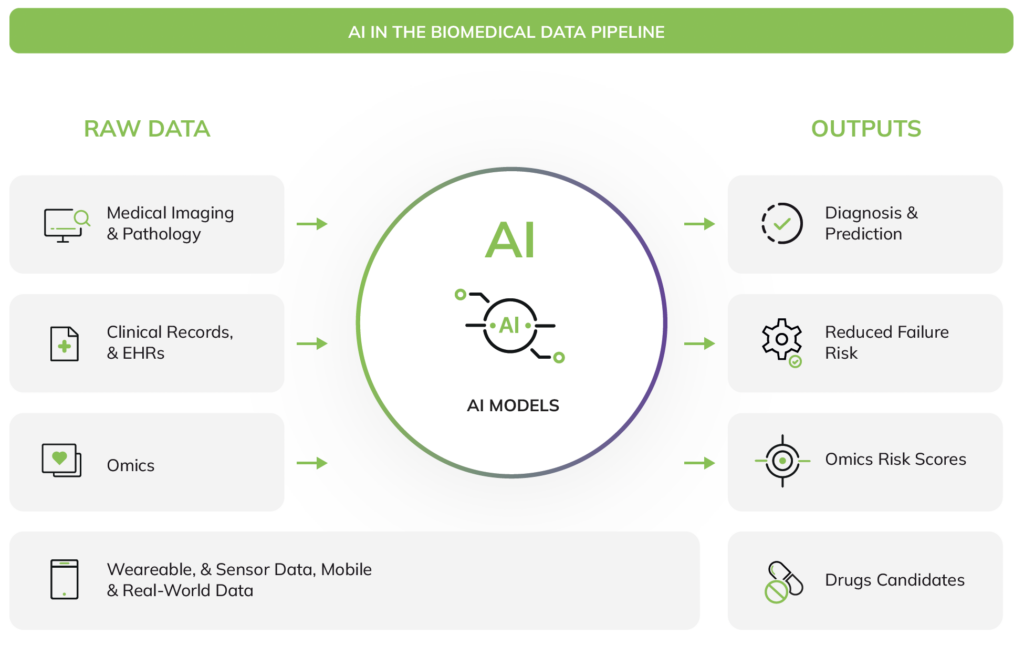
Modern AI in biomedicine is powered by machine learning, deep learning, and natural language processing (NLP), with large language models (LLMs) emerging as new infrastructure for knowledge extraction, summarisation, evidence retrieval, and decision support. Biomedical AI allows the integration of different data types (genomic and proteomic sequences, imaging, clinical data…) into multidimensional models of disease and treatment response.
Performance evaluation, through measures such as precision, recall, and AUC-ROC, is necessary to ensure that AI systems provide real-world clinical utility rather than abstract technical accuracy.
Key Application Areas
MEDICAL IMAGING
This field has seen the most mature adoption of AI, particularly in radiology and pathology. Deep learning models now support anomaly detection, triage, and diagnostic review, improving accuracy and reducing clinician workload. Segmentation and classification technologies, including U-Net architectures and emerging transformer-based vision models, enhance image interpretation, automate routine tasks, and support downstream workflows like surgical planning and digital pathology.
Genomics and Precision Medicine
AI accelerates genomic analysis through faster variant calling, scalable genome annotation, and improved polygenic risk scoring. These capabilities turn complex omics data into actionable insights for selecting therapies, predicting disease susceptibility, and guiding preventative care. Drug–gene interaction modeling further supports precision therapeutics by predicting patient-specific drug responses, informing targeted trial design, and reducing the risk of harmful medical events.
Drug Discovery and Development
AI is reshaping early-stage drug discovery, thanks to models such as AlphaFold and Boltz-2, that enable high-accuracy protein structure prediction and molecular simulation, reducing reliance on costly experimental work. Generative models support de novo drug design, expanding chemical search space and proposing novel compounds optimised for safety and efficacy. These tools shorten R&D timelines, reduce early-stage failure rates, and improve the quality of candidate pipelines.
Electronic Health Records (EHRs)
EHRs, both structured and unstructured, are being processed through AI to enhance predictive modeling, early warning systems, and clinical risk stratification. NLP unlocks insights from clinical notes, enabling more complete documentation, efficient workflows, and better clinical decision support. Patient similarity models help identify subpopulations for personalised interventions and more efficient clinical trials
Robotics and Surgery
AI-enhanced surgical robotics deliver greater precision, minimally invasive procedures, and consistent outcomes, while learning from procedural data to improve over time. Advances in rehabilitation robotics are helping to personalise therapy, adapting it to each patient and scaling recovery services without increasing the staffing needs.
Public Health & Epidemiology
AI improves public health capabilities by predicting outbreaks and helping to allocate resources more accurately. In order to identify populations at risk and to increase the effectiveness and impact of screening programs, personalised prevention models are helping to integrate genetic, lifestyle, and environmental data at scales that were not possible before.
Recent Breakthroughs (2020–2025)
The last five years have seen the rise of domain-specific foundational models (BioGPT, GatorTron, Med-PaLM) that elevate medical reasoning, summarisation, and question answering. Multimodal models that combine imaging, text, and omics data now enable more holistic diagnostic and research insights. Meanwhile, open-source ecosystems, powered by Hugging Face and growing biomedical dataset, have democratised access to advanced tools, accelerating innovation across industry and academia.
Challenges and Limitations
Despite rapid progress, AI in biomedicine faces notable hurdles:
- Bias and lack of fairness risk widening health disparities if data are not representative.
- Interpretability remains essential for clinical trust and regulatory approval.
- Data privacy obligations under GDPR, HIPAA, and international regulations require robust governance and secure data handling.
- Clinical validation and deployment remain slow, as integration into real-world workflows demands rigorous testing and interoperability with existing systems. This might be the biggest bottleneck.
These challenges underscore the need for responsible, transparent AI development and clear governance frameworks.
Future Directions
Real-time AI will increasingly support clinical decision-making at the patient’s bedside, offering actionable insights directly within clinical workflows. Federated learning and privacy-preserving techniques will unlock cross-institution collaboration without compromising patient confidentiality. Human-AI collaboration will become central to healthcare delivery, with clinicians leveraging AI as an augmented intelligence layer rather than a replacement, thereby enhancing accuracy, reducing cognitive load, and improving patient outcomes.
Conclusion
AI has evolved from an experimental technology to a strategic force behind biomedical innovation. These days, it serves as the foundation for developments in public health, drug discovery, genomics, imaging, and clinical decision support. In order to ensure that AI improves healthcare equity, safety, and quality, the next ten years will depend on ethical governance, rigorous validation, and responsible deployment. Precision medicine and patient-centered care will be shaped by organisations that are investing in AI strategy, personnel, and infrastructure now.